

 2Euros.org
This post is also available in:
 Français (French)
Introduction
In 2026, Belgium issues a commemorative 2 euro coin to celebrate the 100th anniversary of the Belgian National Railway Company (SNCB). This program pays tribute to a century of railway history and the evolution of transport in the country. Thus, it underlines the importance of the train in the economic, social and industrial development of Belgium.
The history of railways in Belgium began long before the creation of the SNCB. On May 5, 1835, Belgium inaugurated the first public steam-powered railway line on the European mainland, connecting Brussels to Mechelen. Subsequently, the network underwent significant expansion, paralleling the industrialization of the country. Railways thus became essential for the transport of both passengers and goods.
In 1926, Belgium established the Belgian National Railway Company (SNCB) to reorganize the operation of its railway network. This new public enterprise gradually helped to modernize infrastructure and services. Furthermore, it supported technological transformations, most notably the electrification of lines and the development of modern trains.
Today, the SNCB plays a central role in the daily mobility of the Belgian people. It facilitates travel for a large number of passengers and contributes to the development of public transport. Consequently, this commemorative coin celebrates a century of railway innovations, connections, and progress.
Coin Description
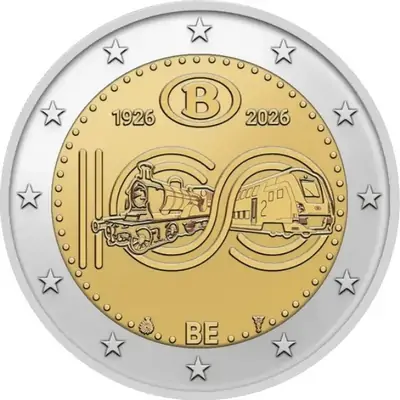
The obverse of the coin features a symbolic composition tracing the 100-year history of the SNCB. At the center, the number “100” forms a highly original graphic motif inspired by railway tracks. The two zeros take the shape of the infinity symbol, while the digit “1” evokes parallel rails. In this way, the design conveys the continuity of the railway network and the connections between different generations of travelers.
Two trains also illustrate the evolution of transport in Belgium. On the left, a 1926 steam locomotive appears, recognizable by its smokestack and mechanical components. In contrast, the right side features a modern train from 2026, whose aerodynamic silhouette evokes technological progress. Furthermore, both vehicles seem to emerge from the curves of the number “100.” This arrangement creates a visual link between the origins of the SNCB and its future.
In the upper part of the central disc is the historic SNCB logo, created in 1935 by Jean De Roy. It consists of a stylized letter “B” surrounded by two concentric ovals. The dates “1926” and “2026” appear to the left and right of the symbol, respectively. They commemorate the one hundred years that have passed since the founding of the railway company.
In the lower section appears the inscription “BE” which denotes the issuing country. It is accompanied by two mint marks: an Erlenmeyer flask topped with an asterisk, and the rod of Mercury. These symbols represent, respectively, the Belgian Mint Master and the Royal Dutch Mint. Furthermore, a series of small dots surrounds the central disc, reminiscent of the traditional borders found on coins. Finally, the outer ring features the twelve stars of the European Union.
Designer Iris Bruijns created this piece by combining railway history with contemporary graphic design. The infinity symbol illustrates the continuity of travel and the connections between different regions. Furthermore, the contrast between a vintage locomotive and a modern train highlights a century of innovation. In this way, the composition pays tribute to Belgium’s railway heritage and the evolution of transport since 1926.
Conclusion
In summary, the 2-euro commemorative coin issued by Belgium in 2026 celebrates the centenary of the National Railway Company of Belgium. It commemorates, in particular, the establishment of this public enterprise in 1926 and its role in the development of national transport.
Through the depiction of a vintage locomotive and a modern-day train, this issue illustrates a century of technological progress. Furthermore, the number “100”—inspired by railway tracks—symbolizes continuity and the connections between generations. The historic SNCB logo also reinforces the heritage aspect of this commemoration.
Thus, this coin serves as a tribute to one hundred years of railway history, innovation, and mobility in Belgium. It also highlights the importance of the train in daily life and in land-use planning. Finally, this issue recalls the role of the railways in the country’s economic and social development.
| Issuing Country: |  |
| Issue Date: | June 15, 2026 |
| Total Mintage: | 157.000 |
| including Proof: | 7.000 |
| including BU: | 150.000 |
| including UNC: | 0 |
| Engraver: | Iris Bruijns |
| Edge: |  |
| Rarity: |   |
| Official Journal: | To be defined |
Would you like to know the technical specifications of this coin? Do not hesitate to consult the page dedicated to the characteristics of a 2 euro coin.

Leave a Reply