

 2Euros.org
This post is also available in:
 Français (French)
Introduction
In 2027, Austria is issuing a 2-euro commemorative coin to mark the bicentenary of the death of Ludwig van Beethoven. A German composer and pianist, Beethoven stands as one of the most influential figures in the history of classical music. This issue thus pays tribute to an artist whose works have left a profound mark on Europe’s musical heritage.
Born in Bonn in December 1770, Ludwig van Beethoven moved to Vienna in 1792 to further his musical training. He studied under figures such as Joseph Haydn and gradually developed a personal style. Subsequently, his compositions helped to evolve the musical forms inherited from the Classical period. Indeed, his work foreshadows several characteristics of Romanticism, most notably through its expressive intensity.
Despite his progressive hearing loss, Beethoven continued his work as a composer. He created nine symphonies, numerous piano sonatas, and the opera Fidelio. Among his most famous achievements is the Ninth Symphony, the final movement of which incorporates the “Ode to Joy“—a melody that would later become the European anthem. The composer died in Vienna on March 26, 1827, leaving behind a substantial musical legacy. Consequently, this piece underscores his significance within the cultural history of both Austria and Europe.
Coin Description
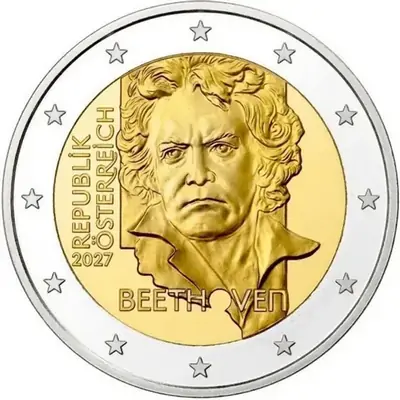
The obverse of the coin features a portrait of Ludwig van Beethoven, shown in a three-quarter view and occupying a large portion of the central disc. His face is notable for its intense gaze, furrowed brows, and serious expression. Furthermore, his abundant, wavy hair serves as an immediately recognizable feature. In this way, the depiction captures several physical characteristics traditionally associated with the famous composer.
The portrait also highlights details of his attire. The raised collar of his coat frames his face, reinforcing his imposing presence. Numerous engraved lines accentuate the movement of his hair and the folds of his clothing. Furthermore, the absence of decorative elements allows the viewer’s attention to focus on the musician’s personality. This restraint lends a solemn quality to the composition.
On the left is the inscription “REPUBLIK ÖSTERREICH” which means “Republic of Austria” in German. It appears vertically, following the outline of the portrait. Just below, the year “2027” marks the bicentennial. In the lower part of the central disc, the inscription “BEETHOVEN” identifies the composer. Furthermore, the typography integrates harmoniously with the design. Finally, the outer ring features the twelve stars of the European Union, in accordance with the specifications for 2-euro coins.
The choice of this portrait underscores Beethoven’s significance within Europe’s cultural heritage. The composer spent a large part of his life in Vienna, where he created his major works. His determined expression also evokes the artistic power that characterizes his compositions. Consequently, this piece combines a personal tribute to Beethoven with a celebration of his influence on the history of music.
Conclusion
In summary, the 2-euro commemorative coin issued by Austria in 2027 marks the 200th anniversary of the death of Ludwig van Beethoven. Featuring an expressive portrait of the composer, this issue pays tribute to a major figure in classical music.
Based in Vienna for the greater part of his career, Beethoven contributed profoundly to the evolution of musical composition. Furthermore, his symphonies, sonatas, and vocal works continue to inspire musicians throughout the world. His legacy thus extends well beyond Austria’s borders.
Moreover, this commemoration holds a distinct European dimension. The theme of the “Ode to Joy” taken from his Ninth Symphony, now serves as the anthem of the European Union. In this way, the piece stands as a tribute to two centuries of musical influence and to a composer whose work remains universal.
| Issuing Country: |  |
| Issue Date: | January 4, 2027 |
| Total Mintage: | 1.007.500 |
| including Proof: | 7.500 |
| including BU: | 0 |
| including UNC: | 1.000.000 |
| Engraver: | |
| Edge: |  |
| Rarity: |   |
| Official Journal: | To be defined |
Do you want to know the technical specifications of this coin? Then, feel free to consult the page dedicated to the characteristics of a 2-euro coin.

Leave a Reply